
Government money will pay for six-month jobs for 562 young Ealing residents. Employers get the wages refunded, and Cabinet accepted the grant on 4 November.
Up to 562 young people in Ealing are expected to get a paid six-month job through the government’s Jobs Guarantee, starting in November. Employers who take them on will have the wages refunded.
The Department for Work and Pensions has confirmed that a bid by the West London Alliance was successful. Ealing Council’s Cabinet was asked to accept the borough’s share of the money on Wednesday 4 November, according to a report published for that meeting.
Updated 5 November: Cabinet accepted the grant for November 2026 to March 2028 on 4 November, according to the draft minutes. An assistant director will agree how many placements the council itself can take. The decision can still be called in, and the council has not yet said how young people will be referred.
Who it is for
The Jobs Guarantee is a national scheme. The council’s report says it offers “fully funded six-month employment opportunities” for young people who:
- are aged 18 to 24
- have been claiming Universal Credit
- have been actively seeking work for 18 months
It runs from November 2026 until 2028. In West London, the West London Alliance of seven boroughs (Barnet, Brent, Ealing, Hammersmith and Fulham, Harrow, Hillingdon and Hounslow) is the lead provider and reports to the DWP. The boroughs deliver it locally.
How many, and when
The report gives indicative numbers for Ealing. Most of the places fall in the scheme’s first full year.
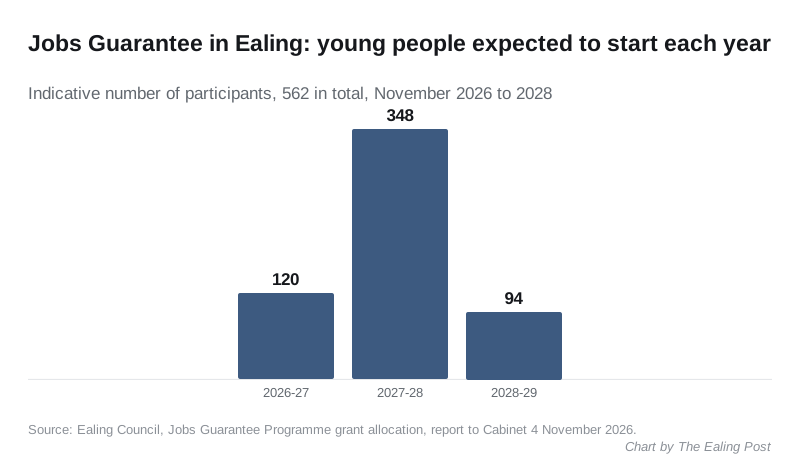
The council’s plan already commits it to supporting about 560 young people who are not in education, employment or training. The report ties the scheme directly to that target.
What employers get
Most of the jobs are meant to be with Ealing businesses, focused on the growth sectors in the council’s jobs and skills strategy. The council expects to host some placements itself.
The DWP repays employers for:
- the young person’s wages, at the National Minimum Wage
- employer National Insurance
- minimum employer pension contributions
- approved onboarding costs
That money goes straight to employers. The report puts the total pot for employers across West London at £24.526 million, all of it passed on.
The money for the council
Separately, the council gets £2,150 for each young person to find jobs, match people to them and support them through the six months. For 562 people that is £1,208,300. The West London Alliance keeps 10% for coordination, leaving Ealing about £1.097 million.
The DWP pays per participant, not by results, the report says. No extra council money is needed for the wages.
Minimum wage or London Living Wage?
The DWP refunds wages at the National Minimum Wage. From April 2026 that is £12.71 an hour for workers aged 21 and over and £10.85 for those aged 18 to 20, the report says.
Ealing Council pays the London Living Wage of £14.80, and says jobs on the scheme “will therefore normally be expected to pay at least the London Living Wage”. Departments hosting a placement would have to find the difference from their own budgets.
The report adds a caveat. Each young person’s circumstances will be considered, including how earnings affect Universal Credit, “to ensure that participation does not inadvertently disadvantage the young person”.
What it means for you
- If you are 18 to 24 and have been on Universal Credit and looking for work for a long time, this scheme is aimed at you. The report does not set out how young people will be referred. It says formal engagement with young people will happen once the grant is accepted. Your Jobcentre work coach is the person to ask.
- If you run a business in Ealing, you could take on a young person for six months with the wage costs refunded. The council says it will engage employers during the implementation phase.
- Cabinet accepted the grant on Wednesday 4 November. The council’s half-year budget report went to the same meeting: our budget story has the figures.
Sources
- Ealing Council, Jobs Guarantee Programme grant allocation, report to Cabinet, 4 November 2026, for every figure above
- Ealing Council, Cabinet, 4 November 2026: agenda
- Ealing Council, Cabinet, 4 November 2026: draft minutes, item 8, for the decision
Have your say