
Inspectors told Ealing on 18 June 2026 that its 2024 to 2039 Local Plan is not sound as drafted, but can be fixed. What has to change, and what happens next.
The most consequential planning decision in Ealing right now is not a single building. It is the Local Plan, the document that will set the rules every application in the borough is judged against until 2039, and on 18 June 2026 the two government inspectors examining it wrote to the council to say it does not pass yet.
Their letter is worth reading in full, because it is unusually direct. The inspectors, Darren McCreery and Carole Dillon, wrote that “considering all the written and oral evidence put to us, including the views of other parties, we are not in a position to conclude that the Plan as currently drafted meets the tests of soundness in paragraph 35 of the National Planning Policy Framework.”
Then, in the next sentence: “Notwithstanding this, it can be made sound through Main Modification. As requested by you, we will recommend the Main Modifications which are necessary for soundness.”
That is not the plan being thrown out. It is the plan being sent back for repairs, with the inspectors setting out exactly which repairs are required.
Where the plan has got to
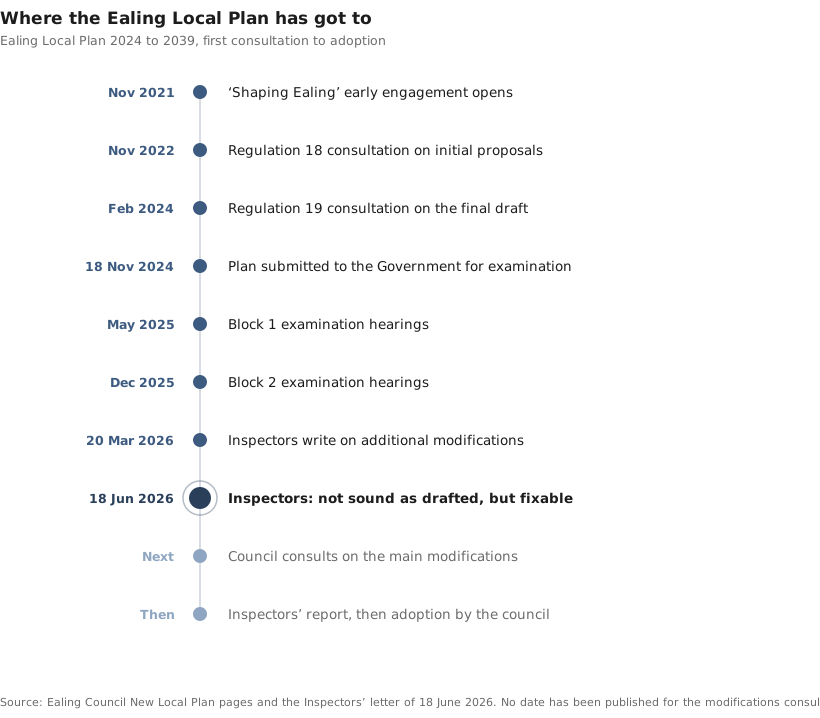
Ealing has been at this for nearly five years. The council opened early engagement, branded “Shaping Ealing”, in November 2021. The statutory Regulation 18 consultation on initial proposals ran from 30 November 2022 to 8 February 2023, with a separate focused consultation on Gypsy and Traveller pitch provision from 5 July to 16 August 2023. The Regulation 19 consultation on the final draft ran six weeks, from 28 February to 10 April 2024.
The council submitted the plan to the government on 18 November 2024. The examination then split into two blocks of hearings: Block 1 in May 2025, and Block 2, rescheduled from earlier in the year, sitting across December 2025 and covering Matters 4 and 6 to 10.
Since then the traffic has been letters. The inspectors wrote with post-hearing advice on 7 July 2025, on post-hearing matters on 14 August 2025 and on strategic policies on 20 August 2025. On 10 March 2026 they gave their opinion on which of the council’s suggested changes counted as additional rather than main modifications, and on 20 March 2026 they wrote formally on additional modifications. The 18 June 2026 letter is the one that matters, because it carries the schedule of main modifications the plan needs to survive.
What actually changes
The inspectors’ Appendix 1 is a long table of specific edits, but three of them tell you what the argument has been about.
The plan supersedes almost everything Ealing currently plans by. Modification FSMM1 spells out that the new plan replaces the Development Strategy 2026 (adopted in 2012), the Development Sites document (2013), the Development Management document (2013) and Planning for Schools (2016) in full. It also replaces the Southall Opportunity Area Planning Framework published in 2014. Ealing has been running on planning documents written over a decade ago, and all of them go at once.
Tall buildings get a softer test. Modification SMM149 applies to more than thirty named development sites across Acton, Ealing, Greenford, Hanwell, Northolt and Southall, and it rewrites the design principle for each one. Where the draft required that height, massing and street layout “are developed in accordance with” the council’s Tall Buildings Strategy, the modified wording says they “are guided by” it, “with any deviation justified”. That is a real change in how much room a developer has to argue.
A commitment at Bollo Lane comes out. Modification SMM41 deletes the line “Maintain active travel connectivity across Bollo Lane” from the West London Orbital entry in the Acton Town Plan’s infrastructure table.
Individual site allocations are being adjusted too. Site 01AC, the Acton Gateway scheme on the Morrisons site, and site 02GR in Greenford both appear in the list with revised boundaries or capacities.
The numbers driving all of it
Ealing’s housing requirement comes from the London Plan rather than from the council. The 2021 London Plan set the borough a ten-year target of 21,570 homes excluding the Old Oak and Park Royal Development Corporation area, or 27,690 for the whole borough including it.
Those figures are a step change, not an increment. The council’s own evidence to the examination sets them against every previous London Plan.
| London Plan | London target | Ealing target |
|---|---|---|
| 2004 | 230,000 | 6,500 |
| 2008 | 305,000 | 9,150 |
| 2011 | 322,100 | 8,900 |
| 2015 alterations | 423,887 | 12,972 |
| 2021 | 522,870 | 21,570 |
Counting the OPDC area, the council calculates the increase between the 2015 and 2021 plans at around 326% for the borough, against 127% for London as a whole.
Delivery has not kept up, and the council does not pretend otherwise. In the 2023 Housing Delivery Test, issued in December 2024 and measuring the years 2020/21 to 2022/23, Ealing delivered 84% of its housing requirement. Anything below 95% obliges a council to publish a housing action plan, which is what Ealing’s “Barriers to Housing Delivery” paper is. It blames a familiar list: the cost of finance, Brexit and Covid, the collapse in off-plan sales from 81% of new London flats in 2016 to 55% in 2024, the end of Help to Buy, and the fact that Ealing’s pipeline is dominated by large high-density schemes that stall rather than slow when conditions turn. The council also notes that 20 London boroughs were in the action plan, buffer or presumption categories in that same test.
A scheme that is actually being built
While the plan is argued over, one of the borough’s largest current developments has reached its highest point. 296 new homes at Twyford Abbey in Acton, built by Latimer, the developer arm of Clarion Housing Group, topped out this summer. Seventy of them will be let at social rent and a further 68 sold through shared ownership, and they range from one to three bedrooms. Completion is expected in spring 2028.
The rest of the scheme is the reason it matters locally. The abbey itself is being restored, and the south lawn, which the council describes as equivalent in size to 16 tennis courts, will open as a public park for the first time in more than 30 years, with play facilities, community growing gardens and an orchard, 157 new trees and new walking and cycling routes.
Council leader Peter Mason said: “It is vital everyone in the borough benefits from the growth in our 7 towns. As well as more affordable homes, this project will also open up valuable green space and community facilities for local people to enjoy.”
Councillor Monica Hamidi, the council’s cabinet member for good growth, said: “This is an important milestone in the restoration of one of the borough’s most historic sites. The much-needed new homes will help address the borough’s housing crisis.”
What it means for you
Nothing you can comment on has opened yet. The inspectors were explicit that they are “not inviting any comments from other parties at this point as there will be a full consultation exercise on the Council’s schedule of Main Modifications in due course”. No date for that consultation has been published.
When it opens, the test is narrow. A main modifications consultation is not another chance to argue for or against a site. It asks whether the specific changes make the plan sound, justified, effective and consistent with national policy. Comments framed that way carry weight. Comments framed as “we do not want this” do not.
Applications carry on regardless. Until the plan is adopted, the borough is still deciding applications under documents written between 2012 and 2016, plus the London Plan. If a site near you is on the allocation list, the modifications being made to its design principles now are what a future application will be judged against.
Watch the tall buildings wording. The shift from “in accordance with” to “guided by” the Tall Buildings Strategy applies to more than thirty sites across six of the borough’s towns. If you live near one, that single edit is the one to read.
The plan also sets what gets built where, which over time is what moves house prices across the borough’s wards, and the construction that follows is what fills the council’s weekly roadworks list.
Frequently asked questions
Has Ealing adopted its new Local Plan?
No. The Ealing Local Plan 2024 to 2039 was submitted for examination on 18 November 2024 and is still being examined. On 18 June 2026 the inspectors said it is not sound as currently drafted but can be made sound through main modifications.
What is Ealing’s housing target?
The 2021 London Plan set a ten-year target of 21,570 homes excluding the OPDC area, or 27,690 including it. That is roughly three times the 2015 target for the borough.
Is Ealing meeting its housing target?
No. In the 2023 Housing Delivery Test, Ealing delivered 84% of its housing requirement, below the 95% threshold that requires a council to publish a housing action plan.
When can I comment on the Ealing Local Plan?
Not yet. The inspectors confirmed on 18 June 2026 that a full consultation on the schedule of main modifications will follow “in due course”. The council has not published a date.
What happens after the modifications consultation?
The inspectors consider the responses, then issue their report setting out the reasons for each final main modification. The council can then adopt the plan.
Which planning documents does the new plan replace?
The Development Strategy 2026 (adopted 2012), Development Sites (2013), Development Management (2013) and Planning for Schools (2016), plus the Southall Opportunity Area Planning Framework of 2014.
Sources
- Letter to the council from the Inspectors on main modifications, 18 June 2026 (PDF), PINS reference A5270/429/9, for the soundness finding, the next steps and every modification quoted here.
- Ealing Council, New Local Plan (Regulation 22), submission and examination for the submission date, the inspectors and the programme officer.
- Ealing Council, New Local Plan consultation history for the Regulation 18 and Regulation 19 consultation dates.
- Ealing Council, New Local Plan examination news for the hearing blocks and the sequence of inspectors’ letters.
- Ealing Council, Barriers to Housing Delivery and Action Plan (PDF) for the London Plan target table, the 84% Housing Delivery Test result and the council’s explanation of the slowdown.
- Around Ealing, High point in abbey’s housing and history project, 5 August 2026, for the Twyford Abbey figures and the quotes from Peter Mason and Monica Hamidi.
We will update this page when the council publishes a date for the main modifications consultation.
Have your say