

Cabinet approved the three-zone policy on 7 October. Homeless households outside the priority groups may get homes over 90 minutes away, even outside London.
Ealing Council has approved a new policy on where it sends homeless households, using three zones based on distance from the borough.
Cabinet agreed the placement policy on Wednesday 7 October. Under it, households that do not meet set priority criteria can be offered homes more than 90 minutes’ travel from Ealing by public transport. That includes homes outside London.
Updated 9 October: the draft cabinet minutes record that the policy was approved as recommended, with the strategic director of housing allowed to make minor amendments before it takes effect. The decision is subject to call-in. Three opposition councillors spoke on the item. The same meeting agreed a two-year lease on The Barn Hotel in Ruislip, used as emergency housing for homeless families, from 9 December 2026 to 8 December 2028.
The cabinet report says the council’s aspiration is still to house everyone in the borough. It says that is not achievable with the homes available.
The three zones
The detailed criteria set out who gets priority for each zone.
| Zone | Where | Who gets priority |
|---|---|---|
| 1 | Inside the borough of Ealing | Households with a child who has an EHCP and attends a specialist school in Ealing; someone needing intensive specialist treatment only available in Ealing; someone with a significant council or NHS care package that cannot be transferred |
| 2 | Within 90 minutes’ travel of Ealing | Someone in settled work for six months at 16 hours a week or more; women on maternity leave who met the same work test; families with a child taking GCSEs, AS, A levels or BTECs; children on a Child Protection Plan, or families helped by Children’s Services where a move would significantly affect their welfare; Ealing’s care experienced young adults under 25 with a personal assistant |
| 3 | Any area, including outside London | Everyone else; households where a risk of gang, drug-related or other violence makes a move out of London preferable; households who want to leave London |
Priority is not a guarantee. The policy itself says a Zone 1 or Zone 2 priority only puts a household ahead of others when a suitable, affordable home is free on the day. If none is, the offer will be “as close to the borough as possible”.
One offer, and what does not count as a reason to refuse
The policy says the council will make one offer of suitable accommodation. If a household unreasonably refuses a suitable offer, the council can end its housing duty to them.
It also lists things that will not normally make an offer unsuitable:
- attending a local school, although exam-year pupils and children with special educational needs get some priority
- the quality of the decoration or furniture
- the layout or type of the home
- no parking, or no garden
Bed and breakfast, inside or outside the borough, “may be considered suitable for short-term interim placements”, the policy says.
Why the council says it needs this
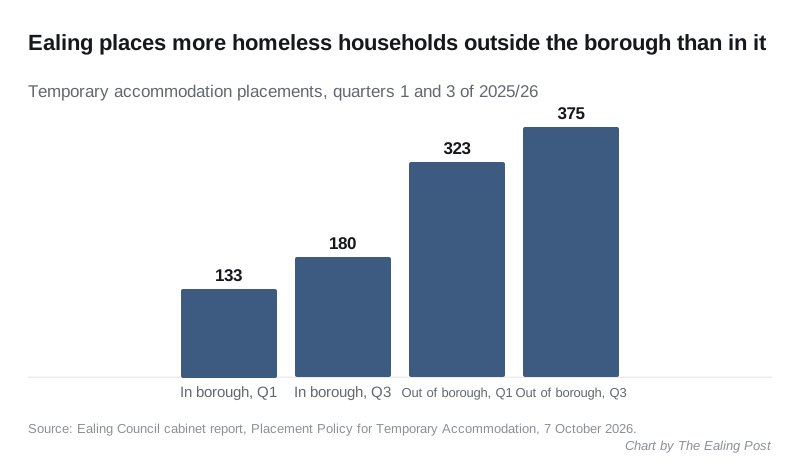
Most placements are already outside the borough. The report gives these figures for the first three quarters of 2025/26, April to December 2025:
- in-borough placements rose from 133 to 180
- out-of-borough placements rose from 323 to 375
- out-of-borough placements were higher than in-borough ones in every quarter
The report blames an acute shortage of affordable homes, rising rents and benefit limits. The policy says caps on housing benefit and Local Housing Allowance rates have cut the number of homes homeless households can afford in Ealing, “particularly larger families”. In many cases, it argues, a home outside the borough will be more sustainable because lower rents help families avoid arrears.
The equality impact assessment compares Ealing with other West London Alliance boroughs and statistical neighbours. It says Ealing had the third highest rate of in-borough placements among them, and the third lowest number of out-of-borough placements. It does not name the other boroughs.
Officers looked at two other options. Doing nothing was rejected because it would leave no consistent framework. An in-borough-only rule was rejected because there are not enough affordable homes to meet demand.
What the council accepts could go wrong
The equality assessment says the policy does not directly discriminate. It does accept that out-of-borough moves may hit some households harder, listing:
- disruption to schooling, healthcare and care arrangements
- loss of family and support networks
- longer and more expensive journeys
- social isolation
It names disabled residents, children with EHCPs, families with safeguarding involvement, care experienced young adults and survivors of domestic abuse as the groups most likely to be affected. The council’s answer is the priority zones, individual suitability checks, the right of review and an annual equality review.
The report says the policy has no direct financial implications.
The policy that went to cabinet was still marked up in places. It refers to “Zone A” and “Zone B” alongside Zones 1 and 2, and points readers to a “Section XX” for review rights. Cabinet let the strategic director for housing make minor amendments before it takes effect.
Your right to challenge
The policy sets out the existing legal routes:
- Ask for a review. Any household can ask the council to review whether an offer is suitable. If the review goes their way, the council makes a further offer.
- Appeal to the County Court. This is only possible on a point of law, and must be brought within 21 days of the review decision.
The report cites the 2015 Supreme Court case Nzolameso v Westminster City Council. That ruling said councils may place households outside their area, but should have a published policy to explain those decisions.
What it means for you
- If you are homeless or in temporary accommodation now, tell your housing officer in writing about work, exams, Child Protection Plans, EHCPs, care packages and specialist treatment. These are the facts that decide your zone.
- If you are offered somewhere far away, you can ask for a review of whether it is suitable. Get advice quickly, because refusing an offer the council judges suitable can end its duty.
- If you need help now, the council’s announcement of the decisions gives its homelessness advice line, 020 8825 8888, and HomelessnessAdvice@ealing.gov.uk. It says a team member will contact applicants within two working days.
- A separate five-year homelessness and rough sleeping strategy was also agreed in draft. The council says it will consult on it in the coming weeks before it is finalised.
Shelter’s emergency housing advice covers suitability reviews and is free.
Sources
- Cabinet report, Placement Policy for Temporary Accommodation and Private Rented Sector Offers, for 7 October 2026, for the recommendations, the placement figures, the options and the legal context.
- Appendix 1, the draft policy, for the one-offer rule, the suitability factors, bed and breakfast, and review rights.
- Appendix 2, detailed placement criteria, for the three zones and their priority groups.
- Appendix 3, equality impact assessment, for the benchmarking and the groups most affected.
- Draft cabinet minutes, 7 October 2026, for the decision, the speakers and The Barn Hotel lease.
- Ealing Council announcement, 8 October 2026, for the advice line and the strategy consultation.
- Cabinet agenda, 7 October 2026, for the time, venue and broadcast.
Have your say