
Ealing has 3,789 licensable HMOs, up 38% in three years, and inspectors found hazards in two of every three they checked. Where they are and what comes next.
Ealing now has 3,789 licensable houses in multiple occupation (HMOs), shared homes where people from more than one household split a kitchen or bathroom. That is 1,043 more than in October 2023, a rise of 38%.
The figures are in a council report to the Overview and Scrutiny Committee, which noted it on Thursday 22 October. The report says most of that growth happened before 2026.
It also shows how often these homes fail inspection. In about two of every three inspections, council officers found at least one hazard.
How many people live in them
The council’s licensed HMOs house 24,705 people in 20,114 households, the report says. On average each one holds six tenants.
HMOs are spread across all seven towns, but not evenly. A study the council commissioned from the housing data firm Metastreet, published in July, counted the licensed HMOs town by town:
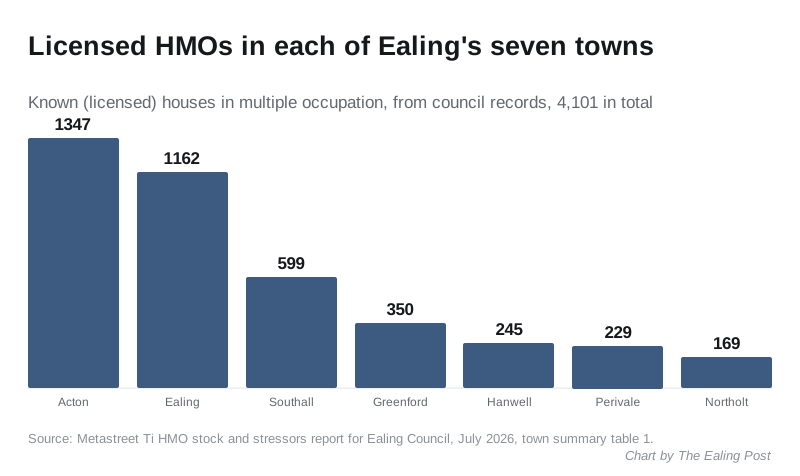
That study’s total of 4,101 is higher than the report’s 3,789. The study drew on council records up to April 2026, and the report uses an August 2026 count of licensable homes. Both come from the council; the town split is only available from the study.
Acton has the most, at 1,347, and more than half of them are smaller HMOs licensed under the council’s extra “additional” scheme. Northolt has the fewest, at 169.
What inspectors found
Between April 2021 and April 2026, officers inspected 903 known HMOs, according to the Metastreet study. They found 4,890 hazards at 595 of them. Of those hazards, 840 were classed as severe.
The council report adds:
- the inspection failure rate was 64.7% for larger HMOs under mandatory licensing and 72.2% for smaller ones under the additional scheme
- the council’s modelling predicts 1,378 licensed HMOs have at least one serious hazard
- 81 licence applications were refused, 277 withdrawn and 37 licences revoked in the periods reported
Southall has the highest predicted rate of serious hazards, 93.3 for every 100 HMOs. Greenford has the lowest, at 19.8.
Noise, rubbish and antisocial behaviour
From April 2021 to April 2026 the council recorded 3,649 antisocial behaviour incidents at known HMOs. They break down as:
| Type | Incidents |
|---|---|
| Waste | 2,004 |
| Noise | 767 |
| Other antisocial behaviour | 507 |
| Serious antisocial behaviour | 371 |
The council has hired three officers to deal with antisocial behaviour at licensed properties and two to deal with waste and environmental crime. A team chasing unlicensed HMOs was set up in 2024. Since April 2025 it has issued 28 civil penalties, and 56 HMOs have become licensed after it stepped in.
The planning side
HMOs are controlled in two ways. Licensing checks a home is safe and properly run. Planning decides whether a house can be turned into one at all.
Since an Article 4 direction took effect, turning a family house into a small HMO has needed planning permission. It came in immediately in Perivale on 30 October 2024, and across most of the rest of the borough on 14 November 2025. The report stresses that this is not a ban.
Up to 17 September 2026, the council received 324 HMO-related planning and certificate applications:
- 137 were permitted or granted
- 103 were refused or are minded to be refused
- 49 were still pending
- 35 were withdrawn or ended another way
The wards with the most applications were Perivale (41), North Acton (30), East Acton (26), Southall Green (23) and South Acton (21). Hanger Hill, Central Greenford and Southall Broadway had 18 each.
What happens next
Ealing’s current additional licensing scheme, which covers smaller HMOs, started on 1 April 2022 and ends on 31 March 2027. The council consulted from July to September on a replacement to run for another five years. It received more than 650 responses.
Those responses will be analysed and reported to Cabinet, which will decide whether to bring in the new scheme. The report says it would focus on fire safety, overcrowding, disrepair, waste, antisocial behaviour and management, with tougher licence conditions on rubbish and behaviour. Proposed fees will be set out in a separate report.
The council is also rewriting its planning guidance on HMOs, after community workshops in September, with a focus on how many are clustered in one area.
What it means for you
- If you rent a room in a shared house, check whether it should be licensed. An unlicensed HMO can mean you are able to reclaim rent through a Rent Repayment Order; the council has sent 748 advice letters about these since April 2025. Ealing’s HMO standards guide sets out what a licensed home must provide.
- If you live next to one with persistent noise or rubbish problems, report it to the council. Licence conditions mean the landlord can be made to deal with it, not just the tenants.
- If you are planning a conversion, you now need planning permission across most of the borough as well as a licence. Keep an eye on new applications through our Ealing planning news page.
Have your say